

Safeguarding Crafts
An International Capacity-Building Programme for Mayors, Municipal Leaders, Professionals and Educators
Jaipur, India
ITEC Multi-Country Course | Organised by the Indian Institute of Crafts & Design (IICD), Jaipur, with the support of the Ministry of External Affairs, Government of India, under the Indian Technical & Economic Cooperation (ITEC) Programme
Click Here to Apply
The Indian Technical & Economic Cooperation (ITEC) Programme
The Indian Technical and Economic Cooperation (ITEC) Programme, instituted by the Ministry of External Affairs, Government of India in 1964, is India's flagship platform for international capacity building and South-South cooperation. It enables partner countries to access Indian expertise, institutional knowledge and practical experience through training and professional exchange, strengthening human-resource capacity and long-term development partnerships. ITEC today reaches more than 160 partner countries and remains an important instrument of India's development partnership and soft-power diplomacy.
In 2026, under this wider capacity-building partnership, the Ministry of External Affairs is joining hands with the Indian Institute of Crafts & Design (IICD), Jaipur, to offer a two-week multi-country programme on Safeguarding Crafts. The programme responds to a shared international challenge: how cities can sustain living craft traditions while strengthening the communities, institutions, education systems, markets and policies that enable them to endure.
IICD, Jaipur: Where Heritage Meets the Future
The Indian Technical and Economic Cooperation (ITEC) Programme, instituted by the Ministry of External Affairs, Government of India in 1964, is India's flagship platform for international capacity building and South-South cooperation. It enables partner countries to access Indian expertise, institutional knowledge and practical experience through training and professional exchange, strengthening human-resource capacity and long-term development partnerships. ITEC today reaches more than 160 partner countries and remains an important instrument of India's development partnership and soft-power diplomacy.
In 2026, under this wider capacity-building partnership, the Ministry of External Affairs is joining hands with the Indian Institute of Crafts & Design (IICD), Jaipur, to offer a two-week multi-country programme on Safeguarding Crafts. The programme responds to a shared international challenge: how cities can sustain living craft traditions while strengthening the communities, institutions, education systems, markets and policies that enable them to endure.
Capacity Building Programme: Safeguarding Crafts
Safeguarding Crafts is a two-week international executive capacity-building programme primarily designed for Mayors and Municipal Leaders senior government and Municipal leaders, policymakers, professionals educators and researchers to explore craft not merely as cultural heritage, but as a living ecosystem of knowledge, communities, livelihoods, enterprise and place.
Rooted in India’s diverse craft traditions and drawing upon its experience in craft policy, artisan and cluster development, education, technology, design, intellectual property, tourism and urban development, the programme examines how cities and communities can safeguard living craft traditions while enabling their continued transmission, relevance, visibility and livelihood potential. Through a carefully integrated combination of expert sessions, policy perspectives, case studies, hands-on craft learning, field immersions and policy laboratories, participants will engage with the interconnected dimensions of Policy & Governance, Craft & Heritage, Livelihoods & Markets, and Education & Transmission. The programme ultimately seeks to equip participants to develop a context-specific Craft Safeguarding Action Plan for their respective countries, supporting resilient craft ecosystems where traditional knowledge can thrive, artisans can prosper, skills can be transmitted across generations, and crafts can contribute meaningfully to the cultural, social and economic vitality of cities and communities.
Who can Participate
- Mayors & Municipal Leaders
- Public Representatives
- Administrators and Policymakers
- Professionals from UNESCO Creative Cities Network (UCCN)
- City Managers
- Educators and Researchers in Crafts
Aim
This capacity-building programme aims to enhance participants’ understanding of the nuances of Intangible Cultural Heritage including living craft traditions, relevant policy frameworks, and practical interventions for safeguarding and strengthening craft heritage. It seeks to equip participants to contribute to an enabling ecosystem in their home countries where traditional crafts can thrive, artisans can prosper, knowledge and skills can be transmitted across generations, and crafts can contribute meaningfully to the cultural, social and economic vitality of cities and communities.
Objectives
By the end of the programme, participants will be able to:
- Understand the concept and significance of safeguarding living craft traditions and the challenges faced by craft communities.
- Examine India's policy frameworks, institutional mechanisms and good practices for safeguarding crafts and promoting artisan livelihoods.
- Explore the role of education, technology, design, markets, tourism and urban development in sustaining and strengthening craft ecosystems.
- Identify appropriate approaches and interventions that governments and other stakeholders can adopt to support crafts and artisan communities.
- Learn from Indian craft clusters, artisans, institutions and field-based initiatives through experiential and hands-on engagement.
- Develop a context-specific Craft Safeguarding Action Project addressing a craft-related challenge in their own city, region or country.
Curriculum
The curriculum is structured around a central premise: safeguarding becomes meaningful when policy frameworks are connected to the people, places, skills and economic systems through which craft traditions remain alive. Each day therefore combines a forenoon component of policy, knowledge and dialogue with an afternoon of practice, immersion and exchange. This programme is based on following seven learning pillars:
-
Understanding Crafts and the Culture of Making
What exactly are we trying to safeguard?
- Crafts as living cultural heritage, tacit knowledge systems and community practices
- Relationship between artisan, material, skill, technique, product and place
- Craft traditions, cultural identity and the culture of making
- Challenges to continuity: loss of skills, changing aspirations, raw materials, mechanization and changing markets
- Safeguarding versus preservation - keeping traditions alive while allowing them to evolve
-
Policy and Governance
What can governments do?
- India's policy and institutional framework for crafts and artisan development
- Government initiatives for skill development, cluster development, infrastructure, technology and artisan support
- Roles of national, state and local governments in safeguarding craft ecosystems
- Institutional convergence and stakeholder partnerships for craft development
- Policy instruments: infrastructure, finance, training, markets, social support, intellectual property and public programmes
-
Technology and Innovation
How can technology strengthen crafts and artisans?
- Technology for documentation, preservation and dissemination of craft knowledge
- Digital tools for design development, prototyping and appropriate production technologies
- Technology for quality improvement, productivity and access to raw materials
- Digital platforms, e-commerce and digital storytelling for artisan and market access
- Opportunities and challenges of AI and emerging technologies in the craft sector
- Establishing provenance and authenticity
-
Designing, Marketing and Positioning Crafts
How can artisans reach better markets and earn better incomes?
- Understanding craft value chains, markets and changing consumer preferences
- Design, product development, quality and packaging for contemporary markets
- Branding, storytelling and positioning of crafts and artisan identity
- Geographical Indications, authenticity and protection against imitation
- Direct marketing, e-commerce, exhibitions, tourism and institutional procurement
-
Crafts, Heritage, Tourism and Cities
How can cities become partners in safeguarding crafts?
- Crafts as part of urban cultural identity, heritage and local economic development
- Craft clusters, historic craft neighbourhoods, markets and cultural spaces
- Role of municipalities in infrastructure, workspaces, public spaces and craft facilities
- Linking crafts with heritage tourism, craft trails, markets and cultural experiences
- Craft-friendly cities: integrating crafts into urban planning, tourism, city branding and local development
-
Knowledge and Education
How does craft knowledge move to the next generation?
- Inter-generational transmission of craft skills, knowledge and cultural meaning
- Master artisans, apprenticeship and learning-by-doing
- Documentation of tacit knowledge, techniques, materials and processes
- Role of schools, vocational education, higher education and design institutions
- Engaging youth and new generations in the future of traditional crafts
Programme Methodology
Learn • Experience • Engage • Apply
The programme adopts an experiential, practice-oriented and participatory learning approach, bringing together policy, expert knowledge, craft practice and field-based engagement. Participants will move between classroom learning, direct interaction with craft communities and applied project development.
- Interactive Learning: Lectures, expert sessions, policy dialogues and keynote addresses.
- Craft Immersion: Hands-on workshops and learning with artisans and craft practitioners.
- Field Engagement: Visits to craft clusters, studios, enterprises, museums and heritage sites.
- Peer Exchange: Comparative reflection and knowledge-sharing across participating cities.
- Diagnostic Exercises: Exploring real craft-sector challenges and identifying context-specific opportunities.
- Applied Project Work: Developing a Craft Safeguarding Action Project addressing a real craft-related challenge from the participant’s city or country.
- Action-Oriented Outcome: Translating programme learning into a practical, locally relevant approach that can be adapted for implementation.
What Participants Will Experience
LEARN: Engage with Indian and international perspectives on craft safeguarding.
MAKE: Experience Indian craft traditions through hands-on workshops.
CONNECT: Interact with artisans, designers, educators, researchers and institutions.
APPLY: Explore approaches that can be adapted to participants' own cities and craft ecosystems.
Key Resource-Persons
Toolika Gupta
Director, IICD Jaipur
Mr. Neeraj Gupta
Academic Advisor, IICD Jaipur
Tarun Bansal
Managing Director, Arya Niwas Hospitality
Neelam Chibbar
Co-Founder Industry Bangalore
Max Miliano Modesty
Co-founder Kalhath Foundation/2mAteliers
Yogesh Chaudhary,
Jaipur Rugs
Scott Frankum
Deep Tech & Crafts
Aayush Kasliwal
Co-founder designer & Managing Director, Ayush Kasliwal
Furniture Design Studio
Nandita Srinath George
Co-founder Creative Dignity
Dileep Baid
Dileep Industries
Rajesh Kumar
President, Fair Trade Forum
Yosha Gupta
Founder, MeMeraki
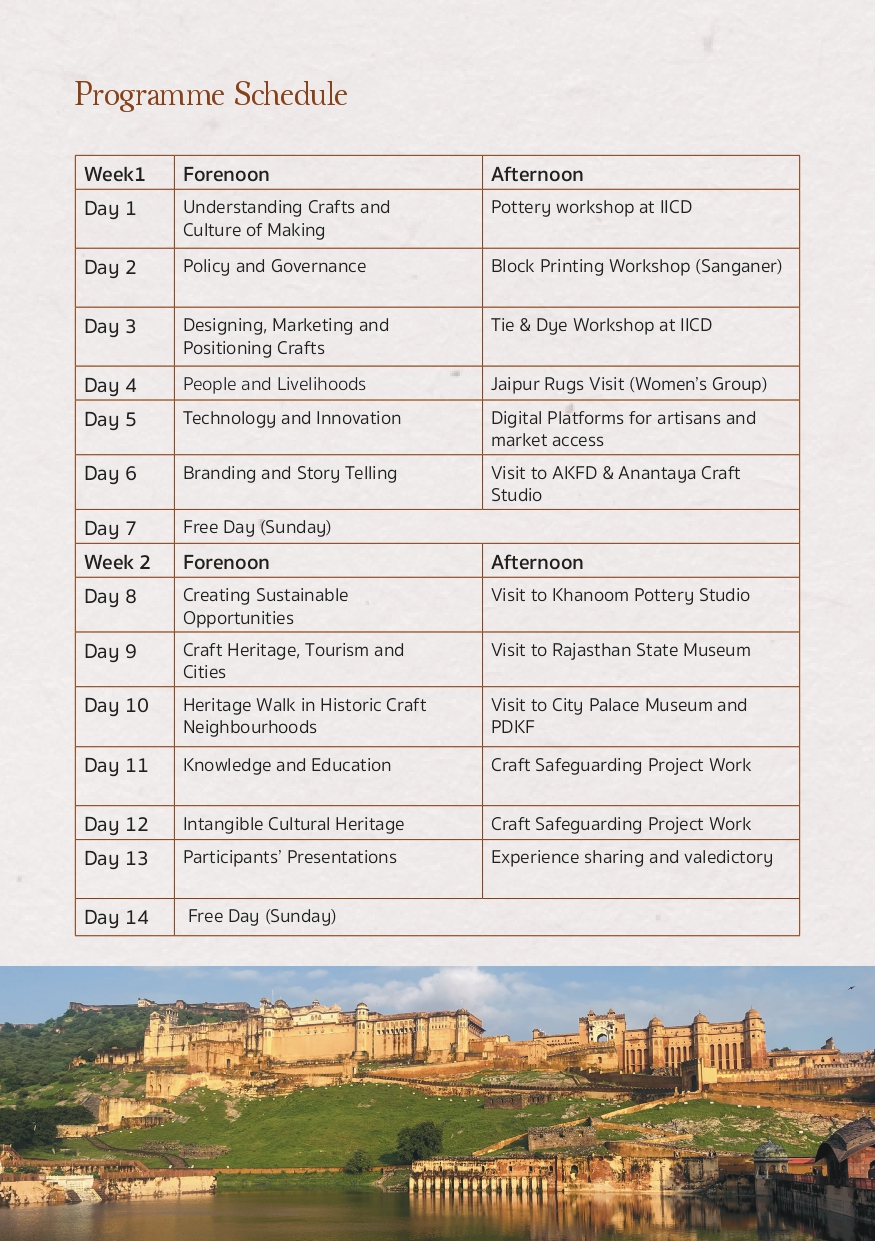
Programme Schedule
| Day/ Date | Forenoon | Afternoon |
|---|---|---|
| Day 1 (Monday) 23rd November 2026 |
Understanding Crafts and Culture of Making |
Pottery workshop at IICD |
| Day 2 (Tuesday) 24th November 2026 |
Policy and Governance | Block Printing Artisans Cluster Visit to Sanganer |
| Day 3 (Wednesday) 25th November 2026 |
Designing, Marketing and Positioning Crafts |
Tie & Dye Workshop at IICD |
| Day 4 (Thursday) 26th November 2026 |
People and Livelihoods | Empowering Women in Rural Rajasthan Jaipur Rugs Visit |
| Day 5 (Friday) 27th November 2026 |
Technology and Innovation |
Digital Platforms for artisans and market access |
| Day 6 (Saturday) 28th November 2026 |
Branding and Story Telling | Visit to AKFD & Anantaya Craft Studio |
| Day 7 (Sunday) 29th November 2026 |
FREE DAY | |
| Day 8 (Monday) 30th November 2026 |
Creating Sustainable Opportunities |
Visit to Khanoom Pottery Studio |
| Day 9 (Tuesday) 1st December 2026 |
Craft Heritage, Tourism and Cities |
Visit to Rajasthan State Museum |
| Day 10 (Wednesday) 2nd December 2026 |
Heritage Walk in Historic Craft Neighbourhoods |
Visit to City Palace Museum and PDKF |
| Day 11 (Thursday) 3rd December 2026 |
Knowledge and Education | Craft Safeguarding Project Work |
| Day 12 (Friday) 4th December 2026 |
Intangible Cultural Heritage | Craft Safeguarding Project Work |
| Day 13 (Saturday) 5th December 2026 |
Participants’ Presentations | Experience sharing and valedictory |
| Day 14 (Sunday) 6th December 2026 |
FREE DAY | |
Experience Jaipur — A Living Craft City
Jaipur offers a unique setting in which to experience the living relationship between heritage, craft, design and urban life. Its historic walled city continues to retain longstanding commercial, artisanal and cooperative traditions, while its identity as a UNESCO Creative City of Crafts and Folk Art reflects the vitality of its craft ecosystem. From traditional craft neighbourhoods, artisan workshops and bustling markets to museums, cultural institutions and contemporary design spaces, the city offers diverse opportunities for learning and exchange. Through heritage walks, field visits and craft encounters, participants can explore how a city can sustain its cultural traditions while connecting them with contemporary livelihoods, creative enterprise and urban development.
Programme Mentor
Prof. (Dr.) Toolika Gupta
Director, IICD Jaipur
director@iicd.ac.in
Mr. Neeraj Gupta
Academic Advisor, IICD Jaipur
ng@iicd.ac.in
Contact Details
IICD, Jaipur Co-Ordinators
Mrs. Rashmi Pareek
Chief Manager (Projects & Incubation), IICD Jaipur
rashmipareek@iicd.ac.in
Ms. Nandita
Projects Manager, IICD Jaipur
nandita@iicd.ac.in
IICD, Jaipur Details
Location:
View on Google Maps
Front Office Contact:
+91-141-2701203 | 2701504
Website:
www.iicd.ac.in